
Modeling of the recorder. What we have learned (and continue to learn) from this simple instrument
Nicolas Giordano, Department of Physics, Auburn University, USA
The recorder and its close cousin, the flue organ pipe, are arguably the simplest of wind instruments. Due to their simplicity, they have been ideal instruments for studying fundamental questions common to virtually all wind instruments. Those studies began more than a century ago, with famous contributions from Helmholtz and Rayleigh (among others), and continue to the present. Over the decades, theory, experiment, and modeling have become more sophisticated, answering many important questions and spawning new ones. Much of this work has been concerned with one simple question: Exactly how does the input of energy via a more or less steady air jet give rise to the oscillations of pressure and air velocity associated with the sound of the instrument? This talk will describe how the understanding of these instruments has evolved, and highlight how recent studies employing direct application of the Navier-Stokes equations have led to new insights.
———-
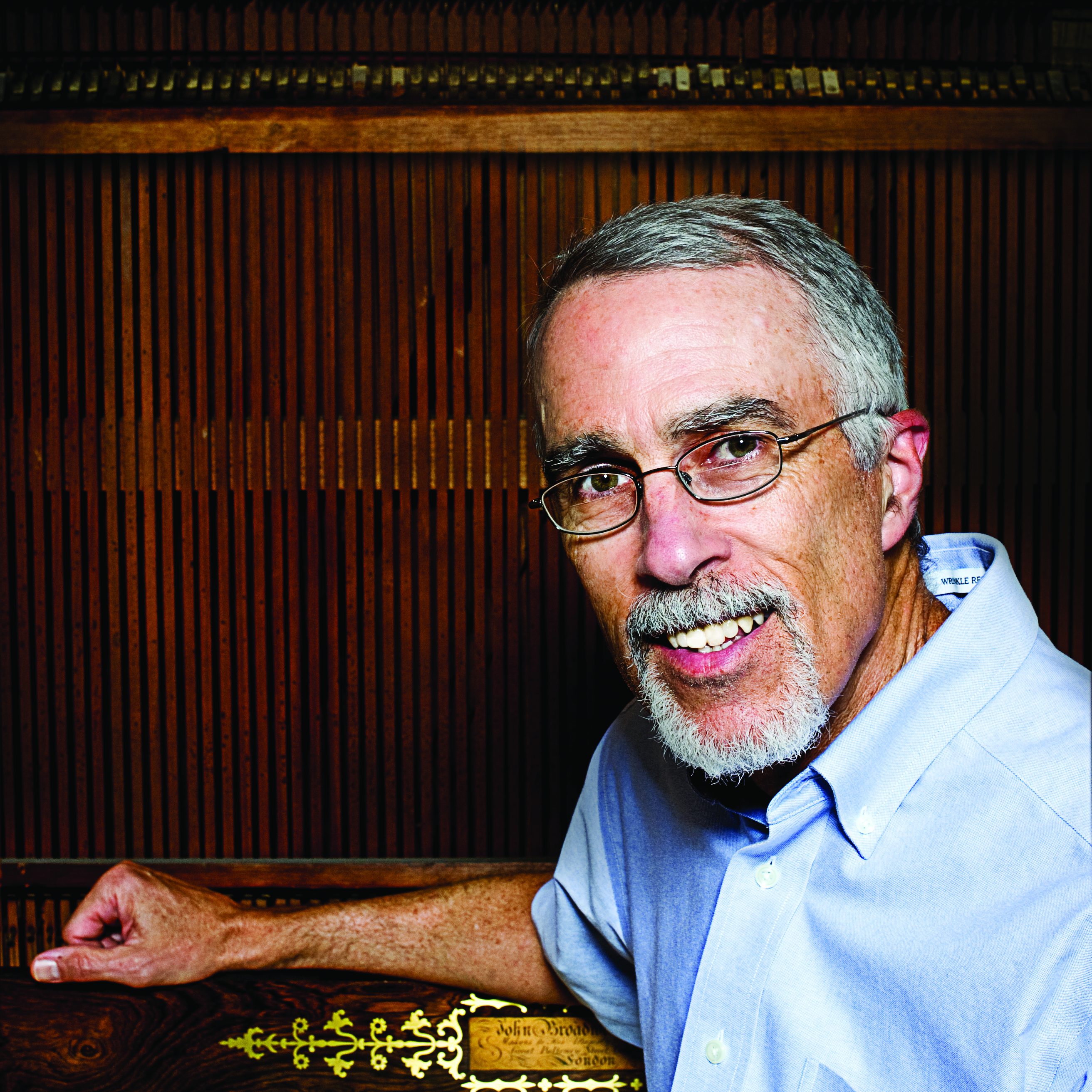
Nicholas Giordano is an Emeritus Professor of Physics who spent time at Purdue University (1979-2013) and Auburn University (2013-2023) prior to retirement. His studies of musical instruments began with work on the piano in the 1990s and later moved into wind instruments. His most recent work has involved computational modeling in which the Navier-Stokes equations are used to model the flow of air through wind instruments. He is also the author of Physics of the Piano, published by Oxford University Press in 2010.
From the Sounds of the Past to the Instruments of the Future: Five Years of NEMUS
Michele Ducceschi, Department of Industrial Engineering, University of Bologna, Italy
This talk presents a retrospective on NEMUS (Numerical Restoration of Historical Musical Instruments, https://nemusproject.eu/), a five-year ERC-funded project at the University of Bologna. Drawing on the conference theme, I will reflect on how advanced mathematical modelling and numerical simulation can be used to study, preserve, and ultimately revive the sound of historical keyboard instruments currently out of playing condition. I will discuss the project’s main research threads — from nonlinear string simulation to real-time physical modelling and haptic control — and offer broader reflections on open-science practices and reproducible methodologies in the context of digital lutherie. The talk will close with a forward-looking perspective on what numerical restoration can offer to the musical acoustics community.
———-

Michele Ducceschi is Associate Professor in the Department of Industrial Engineering at the University of Bologna and Principal Investigator of the ERC Starting Grant project NEMUS. His research spans physical modelling sound synthesis, nonlinear vibration, musical acoustics, and room acoustics, with a strong emphasis on open and reproducible science. Prior to Bologna, he held a Leverhulme Early Career Fellowship and a Royal Society Newton Fellowship at the University of Edinburgh.
 International Symposium on Musical Acoustics